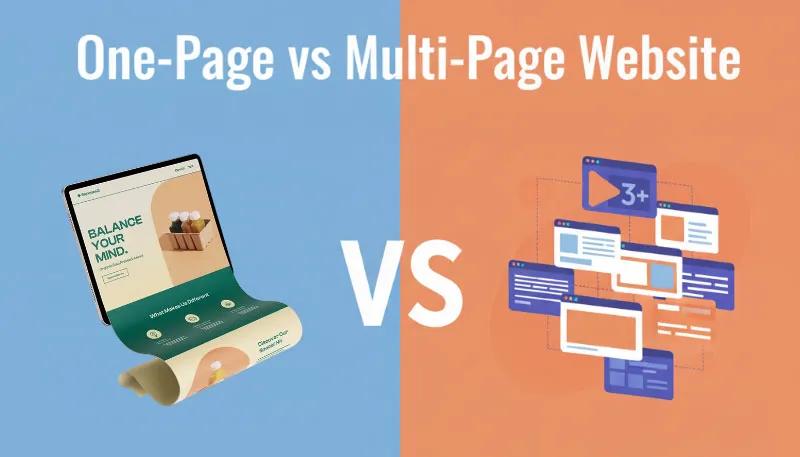
One-Page vs Multi-Page Website: which is better for your business? The short answer is: If you want fast loading, simple messaging, and quick conversions, a one-page website is ideal—perfect for startups, portfolios, or single-service brands.
But if your business offers multiple services, needs better SEO, or plans to scale, a multi-page website is the better long-term choice. Simply put: choose one-page for simplicity, multi-page for growth.
What is a One-Page Website?
A one-page website (also known as a single-page site) displays all of its content on a single scrollable page. Instead of clicking through multiple menus, visitors scroll down to access information. Navigation usually links to different sections of the same page rather than separate pages.
📌 Best For: Portfolios, event pages, product launches.
Examples:
- Portfolio websites for freelancers and creatives
- Event landing pages
- Startup product launches
What is a Multi-Page Website?
A multi-page website consists of multiple pages organized into a structured menu. Each page has a dedicated purpose, such as a homepage, About Us, Services, Blog, and Contact.
📌 Best For: Businesses with multiple services, e-commerce, blogs.
Examples:
- Corporate websites
- E-commerce stores
- Blogs and news portals
When to Choose a One-Page Website
A one-page website works best when your business goals are simple, your message is focused, and you want visitors to act quickly without distractions. Here’s a detailed guide:
- You have a single product or service
If your entire business revolves around one offering, a one-page layout is ideal. It lets you highlight features, benefits, testimonials, and pricing all in one continuous story flow. - You want fast decision-making
A single-page design minimizes clicks, helping users reach the CTA (contact form, signup, or purchase) faster. - You need a landing page for campaigns
Perfect for marketing campaigns, product launches, or events where the main goal is conversion. - You are a freelancer or creative professional
Portfolios, personal branding sites, and resumes are highly effective as one-page websites. Clients can quickly view your work, background, and contact info without browsing multiple sections. - Your target audience is mobile-first
Since scrolling is easier than navigating multiple menus, one-page websites provide a seamless mobile experience. - Budget and time are limited
One-page sites require less development time and fewer resources, making them a cost-effective choice for small businesses or startups.
📌 Bottom Line: Choose a one-page website if you want a fast, focused, and story-driven experience that guides users toward a single action.
When to Choose a Multi-Page Website
A multi-page website is best when your business is more complex, offers multiple services or products, or requires strong SEO visibility. Here’s when it makes sense:
- You offer multiple services or products
If your business spans several categories, each deserves its own page for clarity and discoverability. For example, a digital agency with services like web design, SEO, and PPC should dedicate one page per service. - You need long-term SEO growth
Multi-page websites allow you to target a wide range of keywords. Each page can be optimized for different search intents, helping you build a strong organic presence. - You plan to blog or publish resources
A multi-page site supports a blog section, case studies, whitepapers, and more, which strengthens authority and customer trust. - You run an e-commerce business
Product pages, categories, and filters are essential for online stores, making multi-page sites the only viable option. - You want to track customer journeys
Multiple pages let you analyze user behavior more effectively through analytics, such as which service pages convert best. - You need a professional, enterprise-level presence
Established brands often rely on multi-page websites to present themselves as authoritative and trustworthy. More content also helps build credibility.
📌 Bottom Line: Choose a multi-page website if your business is content-rich, service-diverse, or growth-oriented, and you want long-term SEO and scalability.
One-Page vs Multi-Page Website: Pros and Cons
Here’s a detailed side-by-side comparison of the pros and cons of both website types:
| Aspect | One-Page Website (Pros) | One-Page Website (Cons) | Multi-Page Website (Pros) | Multi-Page Website (Cons) |
|---|---|---|---|---|
| SEO | Simple optimization for branded keywords. | Limited keywords, harder to rank broadly. | Each page can target unique keywords, strong SEO growth. | Requires more effort to optimize each page. |
| User Experience (UX) | Smooth scrolling, focused storytelling. | Can feel cluttered if too much info added. | Structured navigation, easier to organize complex content. | Too many clicks may slow the user journey. |
| Conversion | High focus, one clear call-to-action. | Limited space for nurturing different buyer types. | Multiple CTAs across pages, supports varied user journeys. | Users may get distracted exploring different pages. |
| Design & Layout | Clean, modern, minimal design trends. | Overloading visuals slows loading speed. | Allows creative layouts across sections and categories. | Inconsistent design possible if not well planned. |
| Scalability | Simple structure, quick to launch. | Hard to expand as business grows. | Easy to expand with new services, blog posts, or products. | Requires consistent updates and maintenance. |
| Development Cost | Lower cost, faster setup. | Limited features due to page constraints. | More professional presence with custom features possible. | Higher initial cost and maintenance overhead. |
| Mobile Experience | Scroll-based, smooth on mobile. | Long pages may feel overwhelming on small screens. | Organized navigation, better for large content on mobile. | Can be harder to navigate if menus aren’t optimized. |
| Analytics & Tracking | Easy to track one user journey. | Limited insights into user behavior patterns. | Better data: can see which pages drive traffic/conversions. | Complex analytics setup needed. |
| Best Use Cases | Freelancers, startups, events, portfolios. | Not suitable for large businesses. | Agencies, e-commerce, corporations, blogs, growing businesses. | Overkill for very small or single-purpose websites. |
How to Decide: Key Questions to Ask
Choosing between a one-page and multi-page website doesn’t have to be overwhelming. By asking yourself the right questions, you can make an informed decision that aligns with your business goals and audience needs. Here’s a comprehensive decision framework to guide you through the process.
1. What Are Your Business Goals?
Start by clearly defining what you want your website to achieve. Are you looking to generate leads, sell products, build brand awareness, or provide comprehensive information?
If your primary goal is to drive a single action—like signing up for a newsletter, downloading an app, or registering for an event—a one-page website with a clear call-to-action might be your best bet. The focused nature of one-page sites excels at guiding visitors toward one specific conversion goal.
However, if you have multiple objectives such as selling various product categories, providing customer support, maintaining a blog, and showcasing a portfolio all at once, a multi-page structure will better serve your needs. Multiple goals require multiple pages to prevent overwhelming your visitors.
2. How Much Content Do You Have?
Take inventory of all the content you need to present. This includes text, images, videos, product descriptions, service details, team information, testimonials, and any other materials.
For businesses with limited content—perhaps a freelancer with a brief portfolio, a startup with one core product, or a restaurant with a simple menu—a one-page website can elegantly display everything without feeling cramped. The key is that visitors can consume all your content in a few minutes of scrolling.
Conversely, if you have extensive content like 50+ products, detailed service descriptions, multiple case studies, a resource library, or regular blog posts, you’ll need the organizational structure that only a multi-page website can provide. Cramming too much content onto a single page creates a poor user experience and makes information difficult to find.
3. Who Is Your Target Audience?
Understanding your audience’s preferences and behaviors is crucial. Consider their age group, technical savviness, device preferences, and browsing habits.
Younger audiences, particularly millennials and Gen Z, often appreciate the streamlined, story-driven experience of one-page websites. They’re comfortable with infinite scrolling and tend to browse primarily on mobile devices where one-page sites excel.
Meanwhile, if your audience includes professionals researching B2B solutions, academics seeking detailed information, or any group that prefers to bookmark specific pages and return to particular sections, a multi-page website offers better usability. These users expect traditional navigation patterns and appreciate being able to jump directly to the information they need.
4. What Is Your SEO Strategy?
Search engine optimization requirements should heavily influence your decision. Think about how many keywords you need to target and how competitive your industry is online.
If you’re targeting a single keyword or a very narrow topic—like “Chicago rooftop wedding venue” or “organic cold-pressed juice delivery Miami”—a well-optimized one-page site can rank effectively. The concentrated content signals strong topical relevance to search engines.
However, if your SEO strategy involves ranking for dozens or hundreds of different keywords across various topics—such as “web design services,” “logo design,” “brand identity,” “digital marketing,” and “SEO consulting”—you’ll need multiple pages. Each page can target specific keyword clusters, dramatically increasing your visibility in search results and driving more organic traffic.
5. How Quickly Do You Need to Launch?
Your timeline and budget constraints are practical considerations that can’t be ignored.
One-page websites are significantly faster to design, develop, and launch. If you need a web presence within a few weeks for an upcoming product launch, event, or business opening, a one-page site can get you online quickly without sacrificing quality. It’s also more budget-friendly, making it ideal for startups and small businesses with limited resources.
Multi-page websites require more planning, design work, development time, and testing. Expect a timeline of several weeks to months depending on complexity. If you have the time and budget to invest in a more robust web presence, and you anticipate growing your online presence over time, the initial investment in a multi-page site will pay dividends.
6. What Are Your Growth Plans?
Think beyond your immediate needs and consider where your business will be in one to three years.
If you’re testing a new business concept, validating a market, or operating in a niche that may pivot, starting with a one-page website makes sense. It’s easier and less costly to redesign or completely overhaul when your strategy changes.
However, if you have clear growth plans—like expanding product lines, entering new markets, building a content marketing strategy, or adding e-commerce functionality—start with a multi-page structure. Trying to retrofit a one-page site into a multi-page site later often costs more than building it right from the start. A multi-page foundation provides the scalability your growing business will need.
7. How Important Is Detailed Analytics?
Consider how much data you need to track about user behavior on your site.
With a one-page website, analytics are simpler but less granular. You can track scroll depth, time on page, and which sections get the most interaction, but you can’t easily see distinct user journeys between different topics or content areas.
Multi-page websites offer much richer analytics. You can track which pages attract the most traffic, where users enter and exit your site, conversion rates by page, and detailed user paths. This data is invaluable for optimizing your marketing efforts and understanding what content resonates with your audience.
8. Do You Need E-Commerce Functionality?
Finally, assess your selling requirements if you’re running an online store.
Selling one or a few products? A one-page website can incorporate simple checkout functionality effectively. Many successful crowdfunding campaigns and single-product businesses thrive with this approach.
But if you’re selling multiple product categories, need filtering and search functionality, require detailed product pages with reviews and specifications, or want to build a full-featured online store, a multi-page e-commerce website is non-negotiable. The complexity of online retail demands the organizational structure and functionality that only multi-page architecture can provide.